
Joyin Akindemowo1, Paige Banman1, Kimberly Barrientos1, Kimberly Berthet1*, Maham Kazmi11, Sawyer Findley1, Maham Kazmi1, Yun Mi Mi Khin1, Joshua Mehany1, Thuy Vi Vivian Nguyen1, Clarissa Yiu1
1University of California, Los Angeles (UCLA) Department of Microbiology, Immunology, & Molecular Genetics 609 Charles E Young Dr E, Los Angeles, CA 90024
*kberthet@mednet.ucla.edu
Abstract
This review article analyzes the research study, “Gut microbiota signatures of vulnerability to food addiction in mice and humans,” which investigates the relationship between specific gut bacteria and susceptibility to food-addictive behaviors (Samulėnaitė et al. 2024). Our review evaluates the study’s rationale, methodology and the significance of its findings across both human and mouse models. The researchers hypothesized that increasing gut microdiversity via beneficial bacteria such as Blautia would decrease or prevent food-addictive behaviors and disorders. The article’s strengths include its translational approach and its focus on the gut-brain axis, highlighting the importance of gut microbiota in shaping neurological responses to food. We argue that while the study presents a promising association between increased abundance of bacteria (e.g., Blautia) and reduced vulnerability to food-addictive behaviors, its conclusions remain limited by correlational evidence, insufficient mechanistic explanation and challenges in translating findings between mice and humans. As such, this review emphasizes the need for more rigorous and clinically grounded research before microbiota-based interventions for food addiction can be confidently supported.
Introduction
The research title “Gut microbiota signatures of vulnerability to food addiction in mice and humans” effectively conveys the main topic of the research; it indicates that the study will focus on the bacteria and their impact on food addiction in humans and mice. The title is succinct and quickly gives the reader a clear understanding of what they’re going to be reading about. However, it could be improved upon; they could make it more specific by including which bacteria—Proteobacteria phylum and Actinobacteria—they chose to investigate, but they provide adequate information to explain what the research will cover.
The abstract, divided into clear sections, makes it easy for the reader to follow. It delineates the purpose and approach the authors took to answer the question of the relationship between the gut microbiome and food addiction.
The study is based on the rationale that gut microbiota have been shown to affect brain health and that the same is true conversely. The study references research from 2018 and 2019 that suggests prolonged substance addiction directly kills gut microbiota, which, in turn, can contribute to the neurological pathways that drive addiction (Cryan et al. 2019; Gershon and Margolis 2018). It also cites a study from 2022 that proposes a healthy gut microbiota is essential for brain and body health writ large (Hosomi et al. 2022). In essence, they successfully establish the connection between the brain and the gut microbiome.
The researchers logically draw a link between the overconsumption of “highly palatable” but unhealthy foods and gut dysbiosis, the eventual loss of impulse control in the nucleus accumbens of the brain (Lee 2025). The article addresses the research question: can an increase in the abundance of bacteria of the taxa Actinobacteria, Coriobacteriaceae, Erysipelotrichaceae, Lachnospiraceae, Enterorhabdus, Allobaculum and Blautia genus via dietary supplements prevent the development of food-addictive behaviors in mice and humans? While the study initially is clear in its identifications of how gut, brain health and microbiota are linked, its clarity falters when the researchers include unnecessary detail on the psychopathological effects of alcohol. The level of depth misleads readers into thinking this topic will be a main focus, rather than simply one example. Instead, this connection should either be made later in the introduction or, better yet, in the discussion or conclusion.
The literature review is comprehensive and relevant to the research question. The researchers cite up-to-date research that relates mental disorders to gut dysbiosis (Mayners-Perxachs et al. 2022), substance abuse to the destruction of beneficial gut bacteria (Meckel and Kiraly 2019) and neurological links to obesity and metabolic disorders (Gupta et al. 2020). To provide context for these findings, the authors also examine how the concept of “food addiction” has evolved within the scientific community. The authors track the evolution of how the term ‘food addiction’ was used in the scientific community including its earliest mention in 1956, its notable absence in the Diagnostic and Statistical Manual of Mental Disorders (DSM-5) in 2013 and how the scientific community commonly uses the 2016 Yale Food Addiction Scale (YFAS 2.0) today to measure this disorder (Dennis et al. 2024; Florio et al 2022; Vasiliu 2022). The researchers cite their own 2015 study of the roles of the brain and epigenetic factors in food addiction in mice, eventually building up to the gaps in current research (Mancino et al. 2015). Specifically, the authors highlight that a few studies relate animal models to human models. Additionally, Gupta et al. (2020) has related the occurrence of obesity in humans to a poorly diverse gut microbiota, but not the diversity of gut microbiota to food-addictive behaviors themselves.
This study attempts to fill these two gaps: that human microbiota have not yet been adequately studied, and that specific strains of bacteria have not yet been linked to food-addictive behaviors. Interestingly, the second paragraph, devoted to defining food addiction, is expansive, while the explanation of how previous research identified brain circuits linked to vulnerability is limited to a single sentence. Readers are left asking the level of vulnerability that dysbiosis between the gut and the brain causes and what exact epigenetic mechanisms are responsible for this dysbiosis. Overarchingly, while the study draws from a comprehensive pool of literature and clearly defines two knowledge gaps, the introduction over-relies on sources that track the historical evolution of the term “food addiction” while underemphasizing past experimental results on gut-brain dysbiosis (Pursey et al. 2014). This paper gives more context to the gut-brain connection rather than suggesting an effective approach to mitigating the food addiction concern. This furthers our claim that more clinically grounded research is needed before proposing a microbial alternative intervention for food addiction.
Methods
The study employed a well-structured design to investigate the relationship between gut microbiota composition and food addiction, utilizing both human and animal models for cross-species validation. In the human cohort, participants were classified as food-addicted or non-addicted using the Yale Food Addiction Scale (YFAS) 2.0, while in the animal model, male C57BL/6J mice were subjected to an operant self-administration paradigm with chocolate-flavored pellets to assess addiction-like behaviors (Gearheardt et al. 2016). Interventions in mice included the administration of non-digestible carbohydrates (lactulose and rhamnose) and the probiotic Blautia wexlerae to evaluate potential therapeutic effects.
While the study design was robust, alternative approaches could reduce potential biases in data collection. The reliance on BMI-based classification in humans may not fully capture the complexity of food addiction, as BMI does not distinguish between fat and muscle mass or account for metabolic variations (Pray and Riskin 2023). A more precise approach could involve dual-energy X-ray absorptiometry (DEXA) scans or waist-to-hip ratio measurements to assess body composition more accurately (Krugh and Langaker 2024). Additionally, the self-reported nature of the YFAS 2.0 introduces potential response biases, as participants may underreport or misinterpret their eating behaviors. Objective behavioral assessments, such as food intake monitoring or neuroimaging studies, could complement self-reported measures to provide a more comprehensive evaluation. In the mouse model, the exclusive use of male mice limits generalizability across sexes, as hormonal differences may influence gut microbiota composition and addiction-related behaviors (Org et al. 2016). These limitations undermine translational potential. Future studies should incorporate both male and female cohorts to explore potential sex-based differences in microbiota influence on food addiction.
The study includes appropriate control groups, with non-addicted humans matched for age and sex serving as controls and non-addicted mice undergoing the same experimental conditions without exposure to addiction-like stimuli. However, additional controls could strengthen the study. For example, including a group of mice exposed to a standard diet without operant self-administration would help differentiate the effects of the behavioral paradigm from the specific dietary composition of chocolate-flavored pellets. Similarly, in the human cohort, analyzing gut microbiota in individuals with other forms of compulsive behaviors as a comparison group could provide insights into whether the identified microbiota signatures are unique to food addiction or shared across related conditions. This study would need to establish a causal link between microbiota and food addiction specifically.
The methods are described in sufficient detail to ensure replication, including precise documentation of behavioral assessments and microbiota sequencing techniques. DNA extraction, sequencing and bioinformatics processing followed standardized protocols and the operant conditioning paradigm in mice is clearly outlined, ensuring reproducibility. By incorporating more objective assessments, broader participant inclusion and additional control groups, future research could further refine the understanding of gut microbiota’s role in food addiction.
It’s important to emphasize that the overall methodological issues discussed weaken the translational evidence provided by the study. Variable and non-inclusive measures used in this study such as BMI, self-reported YFAS scores and male-only cohorts can introduce bias or noise that may interfere with the generalizability of the results. Without stringent characterization of these covariates, it becomes unclear whether observed associations between certain taxa, such as Blautia, provide true protective measures against food addiction or if they are simply the result of unmeasured factors in the study. Although the study’s claim provides optimistic insights that manipulating gut microbiota can impact vulnerability to food addiction, this should be approached cautiously as the diversity of human populations makes it challenging to ethically apply these results in a clinical setting without more precise and inclusive methodologies.
Results
The results section explains the importance of every figure in contributing to the overall paper. Some figures could be further explained with additional numerical data or labels. For example, Figures 5H-J mention correlations between addicted and non-addicted humans and mice. The importance and validity of this correlation could be benefited by adding correlation coefficients.
Some results had statistically significant differences, while others did not. For example, Figures 1B-D had statistically significant differences in persistence of response, motivation and compulsivity between addicted and non-addicted mice, while there was no significant difference in pellet intake and body weight between addicted and non-addicted mice. There were also no significant differences between alpha diversity of the non-addicted and addicted mice groups. Some insignificant differences, such as the alpha diversity difference, are somewhat downplayed. The authors do not mention why this insignificance may be important or what this could imply. Overall, the results establish a relationship between the vulnerability to food addictions and gut microbiome composition, however, the mixed significant and non-significant results complicate the interpretations of the results the study’s researchers are analyzing.
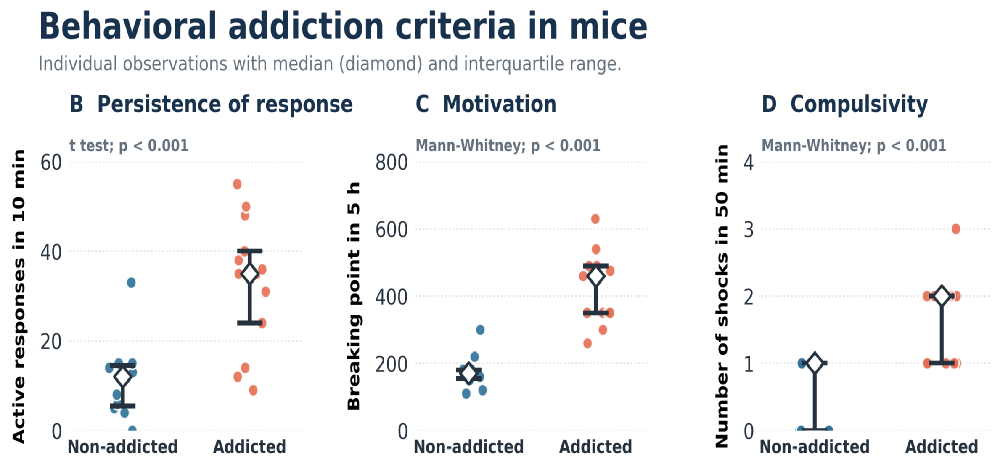
Figure 1. Characterization of extreme subpopulations of addicted and non-addicted mice (B-D). Behavioral tests for the three addiction-like criteria in the late period (individual values with IQR) in the addicted and non-addicted groups. (B) Persistence of response (t-test, ***p < .001). (C) Motivation (Mann-Whitney U-test, ***p < .001). (D) Compulsivity (Mann-Whitney U-test, ***p < .001). Redrawn from Samulėnaitė et al. (2024), Figure 1B-D.
Altogether, the results of the study show a more constrained picture of gut microbiota signatures in food addiction rather than the broad claims the authors are making. However, the significant differences in food addiction-like behaviors and the associations with specific taxa do support the claim that vulnerability to food addiction is linked to the gut microbiota. It is essential to note that the absence of differences in certain variables such as body weight, pellet intake and alpha diversity, coupled with the lack of key statistics (e.g., correlation coefficients in Figures 5H-J) weakens these associations. Furthermore, it raises questions about the scope and generalizability of the findings. Instead of a broad impact that the authors claim, the results indicate more subtle and taxa-specific associations in which clinical implications are uncertain. This pattern supports our argument that although this study produces interesting and optimistic results, the results rely mainly on correlations that are not strong enough to back the translational claims of gut microbiota interventions for food addiction in humans.
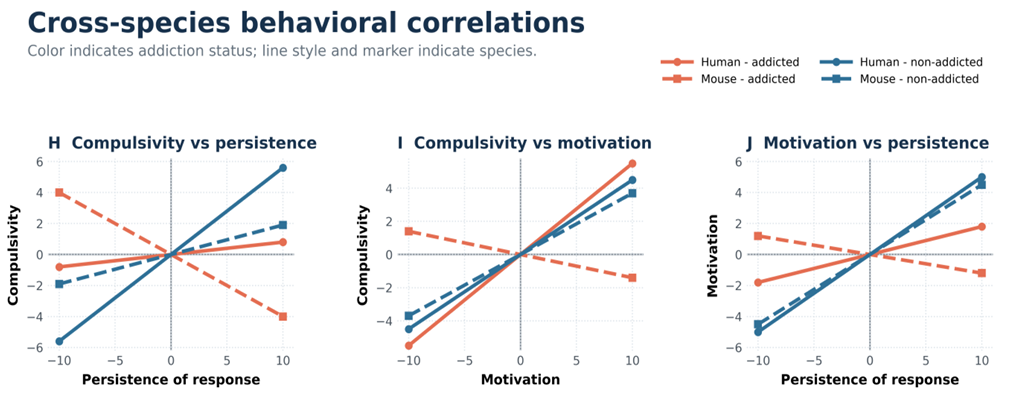
Figure 5. Gut microbiota signatures in humans (H-J). Correlational analyses between persistence of response, motivation, and compulsivity in addicted and non-addicted mice and humans. (H) Compulsivity and persistence of response. (I) Compulsivity and motivation. (J) Motivation and persistence of response. Redrawn from Samulėnaitė et al. (2024), Figure 5H-J
Discussion
The authors interpret their results by breaking down their findings into specific bacterial groups. They identified these bacterial groups by discovering significant gut microbiota signatures that displayed differential bacterial abundance between food addicted and non-addicted mice. They found that four genera of bacteria (Enterorhabdus, Lachnospiraceae, Allobaculum and Blautia) showed beneficial effects as they had a lower abundance in food-addicted mice. Conversely, they also found that two groups of bacteria (Anaeroplasma genus and Gastranaerophilales families) showed non-beneficial effects as they had an increased abundance in food addicted mice.
The authors note the relevance of their findings as the bacterial groups they identified to impact food addiction have been previously associated with the gut-brain axis (Golubeva et al. 2017). They further discuss that these associations could be explained by a bidirectional communication, where the gut microbiota can communicate with the brain via various metabolites and the brain can communicate with the gut microbiota via nervous system signalling pathways. This supports their findings that the bacterial groups they identified contribute to food addiction by functioning under the gut-brain axis system.
The study works mainly with mice microbiota, which only has a 10% overlap with the human microbiota on the species level (Kieser et al. 2022). The authors note that they were able to overcome this by comparing microbiota signatures on the phyla level, which were much more similar. This allows them to make more direct conclusions about the impact of these findings on humans and not just mice. By comparing on the phyla level, the researchers found significant similarities in the behavior of food addiction and the microbiota signatures associated with the behavior between their mice and human groups. Additionally, they noted that the differences in the relative abundance of certain bacterial phyla between non-food addicted and food addicted humans were in the same direction as the mouse models. This adds strength to their translational model; however, the authors lack any discussion of the limitations of this approach. Since there is very little microbiota overlap at the species level between humans and mice, their findings and conclusions should be more reserved (Bautista et al 2025; Cani et al 2021; Turjeman 2025). Although the results are optimistic, this study would benefit from a different animal model that has a more similar gut microbiota signature to humans.
The authors additionally extend their findings to various other implications. One of the main ones they discuss is the impact of these microbiota signatures on individuals with alcohol use disorder. They note how previous findings with alcohol use disorder show opposite effects on the bacterial groups they identified, indicating that the relative abundance of these bacterial groups determines if their effect is beneficial or non-beneficial (Deng et al. 2021). For example, Allobaculum showed beneficial effects in their food addiction model but non-beneficial effects in previous studies with alcohol use disorder (Xu et al. 2019). The authors note how these differences in results are controversial, which leads them to conclude that characterization of any beneficial effects of a bacteria may depend on the species. This is concerning as their study utilizes a translational model between two different species as well. If beneficial effects do depend on bacteria, then the results of this study would become less significant.
They further related their findings to the microbiota of individuals with Autism Spectrum Disorder, Schizophrenia and social behavior disorders such as drug use. This further supports their idea that the gut-brain axis can control the persistence of the response based on the levels of certain bacterial groups. These implications are realistic because previous findings have identified the same bacteria groups that have an impact on the disorders, displaying a significant overlap that should be looked into more. Despite this, these statements in the study seem to be more speculative as they briefly reference past studies instead of adding to their findings. The goal of these implications seems to encourage other scientists to further investigate the gut-brain relationships rather than concretely proving them in the paper. The paper would benefit, however, had the authors made this clearer. Overall, the observations highlight the possible role of the gut microbiome in predisposing individuals to food addiction as well as helping understand the mechanisms behind this behavioral disorder and potentially others as well.
The authors note that their findings are derived from a translational model. As stated previously, since the microbiota of mice and humans are different, the authors compared on the higher-order phylum level. Although a direct, species-level comparison could not be made, the authors emphasized that the translational model still works well. However, this may be overstated as the authors do not address any obstacles with this approach. They note that these findings would be difficult to implement therapeutically due to the complicated technique. Lastly, they also discuss that some previous findings have produced controversial results (Gupta et al. 2020), highlighting the need for more work to be done beyond analyzing food addiction disorder.
Generally, this study is intriguing but limited in the viability of its claims. There are clear strengths in the association between specific taxa and food addiction-like behaviors, with intriguing insights into the evolving research in the gut-brain axis. However, the reliance on phylum-level comparisons between mice and humans, mixed results in various disorders (e.g., alcohol use disorder) and the more speculative application of findings to conditions, like ASD and schizophrenia, raise questions as to how these results can be confidently generalized. Therefore, these results make the feasibility and integrity of microbiota-based interventions ambiguous. For example, altering populations of Blautia in the gut of humans would require safe methods to make these adjustments and careful monitoring of metabolic and psychiatric consequences. Furthermore, there are issues in access and equity that need to be addressed in who would receive this treatment. This study provides a solid basis for the concept of microbiota-based interventions that motivates further laboratory and clinical research rather than clear evidence that this type of intervention should be used in a clinical setting for food addition and other disorders.
Conclusion
In the conclusion, the authors provide new information on the microbiota of interest, Blautia, through a quick synopsis of previous studies that have shown Blautia’s potential to regulate metabolism (Freitas et al. 2022; Liu et al. 2020). The conclusion adequately summarizes the type of research performed on human and mice gut microbiomes (translational) and its correlation to food addiction, thus supporting the main objective of the study. One limitation of the study is that the researchers were unable to find a significant difference in the dopaminergic system, correlated with reward systems and food addiction, after Blautia was administered to the test subjects (Domingo-Rodriguez 2020). Although the research article states that other potential avenues of research may continue examining alternative neurological pathways with influences from the gut microbiota, it is unclear which specific biochemical pathways the researchers could be alluding to. Additionally, the researchers note that understanding the degree to which microbiota in the gut influence food addiction may allow for the innovation of new therapies targeted towards curbing food behaviors. However, as the researchers note, more studies must be conducted on the influence of both beneficial and non-beneficial gut microbiota in order to understand the potential factors that may place certain individuals at higher risk for food addiction. With the current literature on Blautia and its potential influences on food addiction, it is important to note that therapeutic interventions that implement changes to gut microbiota may also bring ethical or health-related concerns to human populations.
References
Bautista, J., Echeverría, C.E., Maldonado-Noboa, I., Ojeda-Mosquera, S., Hidalgo-Tinoco, C. and López-Cortés, A. (2025) ‘The human microbiome in clinical translation: from bench to bedside’, Frontiers in Microbiology, 16, 1632435, available: 10.3389/fmicb.2025.1632435.
Cani, P.D., Moens de Hase, E. and Van Hul, M. (2021) ‘Gut microbiota and host metabolism: from proof of concept to therapeutic intervention’, Microorganisms, 9(6), 1302, available: 10.3390/microorganisms9061302.
Cryan, J.F., O’Riordan, K.J., Cowan, C.S.M., Sandhu, K.V., Bastiaanssen, T.F.S., Boehme, M., Codagnone, M.G., Fulling, C., Golubeva, A.V., Guzzetta, K.E., Marriott, A.M., Moloney, G.M., Morelli, E., Morillas, E., O'Connor, R., Cruz-Pereira, J.S., Peterson, V.L., Rea, K., Ritz, N.L., Sherwin, E., Spichak, S., Teichman, E.M., van de Wouw, M., Ventura-Silva, A.P., Wallace-Fitzsimons, S.E., Zatorski, H. and Dinan, T.G. (2019) ‘The microbiota–gut–brain axis’, Physiological Reviews, 99(4), 1877–2013, available: 10.1152/physrev.00018.2018.
Deng, Y., Zhou, M., Wang, J., Yao, J., Yu, J., Liu, W., Gao, R. (2021). ‘Involvement of the microbiota-gut-brain axis in chronic restraint stress: disturbances of the kynurenine metabolic pathway in both the gut and brain’, Gut microbes, 13(1), 1869501, available: 10.1080/19490976.2020.1869501.
Dennis, K., Barrera, S., Bishop, N., Nguyen, C. and Brewerton, T.D. (2024) ‘Food addiction screening, diagnosis and treatment: a protocol for residential treatment of eating disorders, substance use disorders and trauma-related psychiatric comorbidity’, Nutrients, 16(13), 2019, available: 10.3390/nu16132019.
Domingo-Rodriguez, L., Ruiz de Azua, I., Dominguez, E., Senabre, E., Serra, I., Kummer, S., Navandar, M., Baddenhausen, S., Hofmann, C., Andero, R., Gerber, S., Navarrete, M., Dierssen, M., Lutz, B., Martín-García, E. and Maldonado, R. (2020) ‘A specific prelimbic-nucleus accumbens pathway controls resilience versus vulnerability to food addiction’, Nature Communication, 11, 782, available: 10.1038/s41467-020-14458-y.
Florio, L., Lassi, D.L.S., de Azevedo-Marques Perico, C., Fagnani, R., Rodrigues, B.M., Zunszain, P.A., Fernandes, B.S. and Brietzke, E. (2022) ‘Food addiction: a comprehensive review’, Journal of Nervous and Mental Disease, 210(11), 874–879, available: 10.1097/NMD.0000000000001555.
Freitas, R.G.B.d.O.N., Vasques A.C.J., Fernandes, G.d.R., Ribeiro, F.B., Solar, I., Barbosa, M.G., Pititto, B.d.A., Geloneze, B. and Ferreira, S.R.G. (2022) ‘Associations of Blautia Genus With Early-Life Events and Later Phenotype in the NutriHS’, Front. Cell. Infect. Microbiol., 12, 838750, available: 10.3389/fcimb.2022.838750.
Gershon, M.D. and Margolis, K.G. (2021) ‘The gut, its microbiome, and the brain: connections and communications’, Journal of Clinical Investigation, 131(18), e143768, available: 10.1172/JCI143768.
Golubeva, A.V., Joyce, S.A., Moloney, G., Burokas, A., Sherwin, E., Arboleya, S., Flynn, I.,
Khochanskiy, D., Moya-Pérez, A., Peterson, V., Rea, K., Murphy, K., Makarova, O., Buravkov, S., Hyland, N.P., Stanton, C., Clarke, G., Gahan, C.G.M., Dinan, T.G. and Cryan, J.F. (2017) ‘Microbiota-related changes in bile acid & tryptophan metabolism are associated with gastrointestinal dysfunction in a mouse model of autism’, EBioMedicine, 24, 166–178, available: 10.1016/j.ebiom.2017.09.020.
Gupta, A., Osadchiy, V. and Mayer, E.A. (2020) ‘Brain-gut-microbiome interactions in obesity and food addiction’, Nature Reviews Gastroenterology & Hepatology, 17(11), 655–672, available: 10.1038/s41575-020-0341-5.
Hosomi, K., Saito, M., Park, J., Murakami, H., Shibata, N., Ando, M., Nagatake, T., Konishi, K.,
Ohno, H., Tanisawa, K., Mohsen, A., Chen, Y.A., Kawashima, H., Natsume-Kitatani, Y., Oka, Y., Shimizu, H., Furuta, M., Tojima, Y., Sawane, K., Saika, A., Kondo, S., Yonejima, Y., Takeyama, H., Matsutani, A., Mizuguchi, K., Miyachi, M. and Kunisawa, J. (2022) ‘Oral administration of Blautia wexlerae ameliorates obesity and type 2 diabetes via metabolic remodeling of the gut microbiota’, Nat Commun., 13, 4477, available: 10.1038/s41467-022-32015-7.
Kieser, S., Zdobnov, E.M. and Trajkovski, M. (2022) ‘Comprehensive mouse microbiota genome catalog reveals major difference to its human counterpart’, PLoS Computational Biology, 18(3), e1009947, available: 10.1371/journal.pcbi.1009947.
Krugh M. and Langaker M.D. [Updated 2024 May 20]. Dual-Energy X-Ray Absorptiometry. In: StatPearls [Internet]. Treasure Island (FL): StatPearls Publishing; 2025 Jan-, available: https://www.ncbi.nlm.nih.gov/books/NBK519042/.
Lee, S.H., Han, C. and Shin, C. (2025) ‘IUPHAR review: Microbiota–gut–brain axis and its role in neuropsychiatric disorders’, Pharmacological Research, 216, 107749, available: 10.1016/j.phrs.2025.107749.
Liu, X., Mao, B., Gu, J., Wu, J., Cui, S., Wang, G., Zhao, J., Zhang, H. and Chen, W. (2021)
‘Blautia—a new functional genus with potential probiotic properties?’, Gut Microbes, 13(1), available: 10.1080/19490976.2021.1875796.
Mancino, S., Burokas, A., Gutiérrez-Cuesta, J., Gutiérrez-Martos, M., Martín-García, E., Pucci, M., Falconi, A., D'Addario, C., Maccarrone, M. and Maldonado, R. (2015) ‘Epigenetic and Proteomic Expression Changes Promoted by Eating Addictive-Like Behavior’, Neuropsychopharmacol, 40, 2788–2800, available: 10.1038/npp.2015.129.
Mayneris-Perxachs, J., Castells-Nobau, A., Arnoriaga-Rodríguez, M., Martin, M., de la Vega-Correa,
L., Zapata, C., Burokas, A., Blasco, G., Coll, C., Escrichs, A., Biarnés, C., Moreno-Navarrete, J.M., Puig, J., Garre-Olmo, J., Ramos, R., Pedraza, S., Brugada, R., Vilanova, J.C., Serena, J., Gich, J., Ramió-Torrentà, L., Pérez-Brocal, V., Moya, A., Pamplona, R., Sol, J., Jové, M., Ricart, W,. Portero-Otin, M., Deco, G., Maldonado, R. and Fernández-Real, J.M. (2022) ‘Microbiota alterations in proline metabolism impact depression, Cell metabolism, 34(5), 681–701, available: 10.1016/j.cmet.2022.04.001.
Meckel, K.R. and Kiraly, D.D. (2019) ‘A potential role for the gut microbiome in substance use disorders’, Psychopharmacology, 236(5), 1513–1530, available: 10.1007/s00213-019-05232-0.
Org, E., Mehrabian, M., Parks, B. W., Shipkova, P., Liu, X., Drake, T. A. and Lusis, A. J. (2016) ‘Sex differences and hormonal effects on gut microbiota composition in mice’, Gut microbes, 7(4), 313–322, available: 10.1080/19490976.2016.1203502.
Pray, R. and Riskin, S. (2023) ‘The History and Faults of the Body Mass Index and Where to Look Next: A Literature Review’, Cureus, 15(11), e48230, available: 10.7759/cureus.48230.
Pursey, K. M., Stanwell, P., Gearhardt, A. N., Collins, C. E. and Burrows, T. L. (2014). The prevalence of food addiction as assessed by the Yale Food Addiction Scale: a systematic review. Nutrients, 6(10), 4552–4590, available: 10.3390/nu6104552.
Samulėnaitė, S., García-Blanco, A., Mayneris-Perxachs, J., Domingo-Rodríguez, L., Cabana-Domínguez, J., Fernàndez-Castillo, N., Gago-García, E., Pineda-Cirera, L., Burokas, A., Espinosa-Carrasco, J., Arboleya, S., Latorre, J., Stanton, C., Hosomi, K., Kunisawa, J., Cormand, B., Fernández-Real, J.M., Maldonado, R. and Martín-García, E. (2024) ‘Gut microbiota signatures of vulnerability to food addiction in mice and humans’, Gut, 73(7), 1231–1245, available: 10.1136/gutjnl-2023-331445.
Turjeman, S., Rozera, T., Elinav, E., Ianiro, G. and Koren, O. (2025) ‘From big data and experimental models to clinical trials: iterative strategies in microbiome research’, Cell, 188(5), 1178–1197, available: 10.1016/j.cell.2025.01.038.
Vasiliu, O. (2022) ‘Current status of evidence for a new diagnosis: food addiction—a literature review’, Frontiers in Psychiatry, 12, 824936, available: 10.3389/fpsyt.2021.824936.
Xu, Z., Wang, C., Dong, X., Hu, T., Wang, L., Zhao, W., Zhu, S., Li, G., Hu, Y., Gao, Q., Wan, J., Liu, Z. and Sun, J. (2019) ‘Chronic alcohol exposure induced gut microbiota dysbiosis and its correlations with neuropsychic behaviors and brain BDNF/Gabra1 changes in mice’, BioFactors, 45, 187–199, available: 10.1002/biof.1469.
Acknowledgments
The authors thank the Department of Microbiology, Immunology and Molecular Genetics at UCLA for providing instructional support. Additional thanks to the instructional staff and academic coordinators who helped facilitate the MIMG 101 course. The authors also thank the students in the Winter 2025 course cohort for their collaborative spirit and commitment to academic excellence.